Blog / 2011 / Territory Versus Hierarchy
May 5, 2011
I recently skimmed Steven Pressfield’s 2002 book The War of Art.
Skimmed because the premise doesn’t apply to me: I almost never have trouble starting or finishing a creative project.
Skimmed because when the author compared ill health to drug addiction and other things that people do to “draw attention” to themselves I realized the book was written by a moron who needs to develop a chronic disease in order to understand the first thing about empathy.
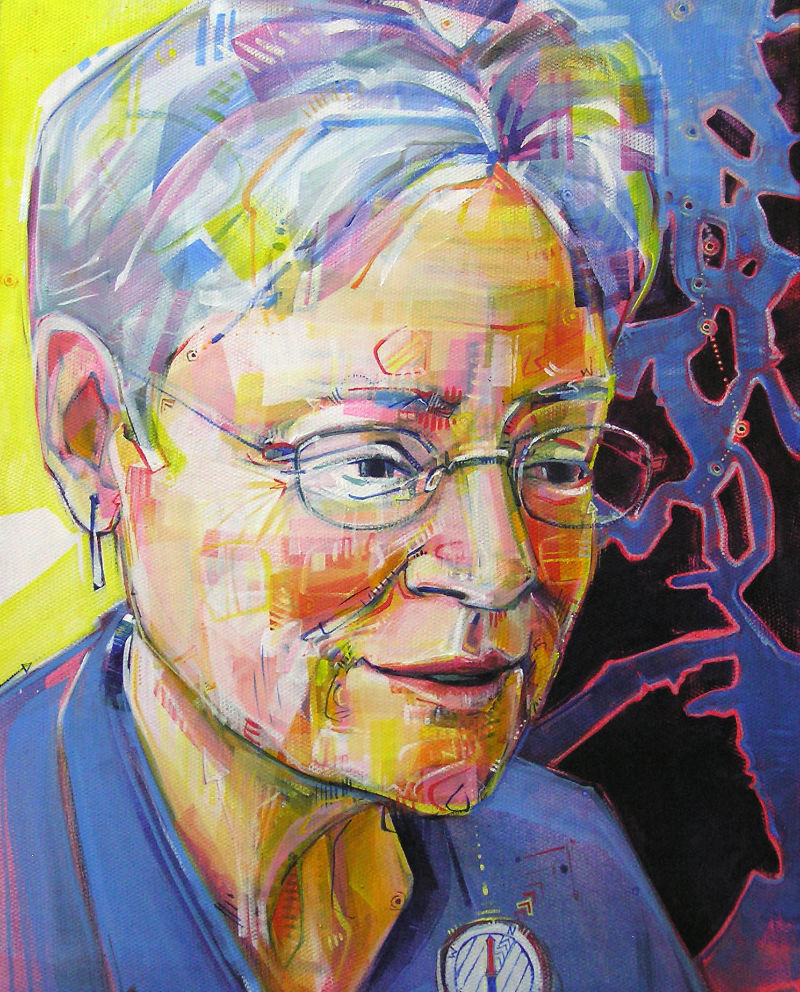
Before: Menopause
2006
acrylic on bird’s eye piqué
30 x 24 inches
(Part of this series of “before” and “after” portraits.)
The part of the book that I actually read and the reason why I’m writing about it now was the part at the end about hierarchy and territory.
Pressfield explains that “in the animal kingdom, individuals define themselves in one of two ways—by their rank within a hierarchy (a hen in a pecking order, a wolf in a pack) or by their connection to a territory (a home base, a hunting ground, a turf).” He goes on to talk about why artists must define themselves by territory—albeit a psychological territory instead of a physical one—and not by hierarchy.
As an example, he talks about what real artists do when they’re feeling anxious. Instead of calling up friends looking for reassurance in a typical hierarchy-thinking move, they go to their studio and do what they love. They delve into their territory to find stability.
He believes that real artists would create even if they were the last person on Earth. They don’t need external input: they need only their territory.
I like this theory and I think there’s a good deal of truth to it.
I often find myself annoyed by the hierarchies of the world and especially of the art world. After all, aren’t artists supposed to be revolutionaries? Anti-establishment? Truly creative? Why do we remake the petty hierarchies of the rest of the world within the art community?
I tend to think that the artists who focus too much on who they know in the community and on leveraging these insider relationships have missed the point.
Still, Presserfield’s theory doesn’t take into account one key factor: art is about communication.
I may not paint so that people will pay attention to me, but I do paint so that people will pay attention to what I’m painting about. I paint to start a conversation. If there was no one at the other end of the dialogue—if I were the last person on Earth—I’m fairly certain I wouldn’t paint like I’m painting now. I might not even paint at all.
I think people like to make extreme statements, mantras of sorts. Some like to say “create with your audience in mind or you won’t have one” and others (including Presserfield) are more of the “it’s all about you” persuasion. The former believe that a creative must recognize that the other person is more important, while the latter think that art can and should be created in a vacuum of pure self-expression.
I think those in the first group are right until they’re wrong. When artists think too much about their audience, they eventually forget what they have to say. And I think the second group is not in touch with reality. To some degree, we have to think in a hierarchy way since we create culture in the context of the society we live in.
I prefer the middle path.
I need an audience for my art or it has no meaning, but at the same time I don’t undersell myself. I am interesting and what I have to communicate is worthwhile, so I don’t need to worry about pleasing the audience so much as engaging them.
It’s the only sane way to be an artist: a lot of territory-thinking with some practical hierarchy-thinking thrown in!
Maybe this post made you think of something you want to share with me? Or perhaps you have a question about my art? I’d love to hear from you!
To receive an email every time I publish a new article or video, sign up for my special mailing list.
If you enjoyed this post, Ko-fi allows you to donate. Every dollar you give is worth a bajillion to me!