Blog / 2018 / Crosshatch Painting
March 19, 2018
The influences that shaped my style have been a regular topic on my blog from the beginning, with this post about my brushes being one of my most popular articles.
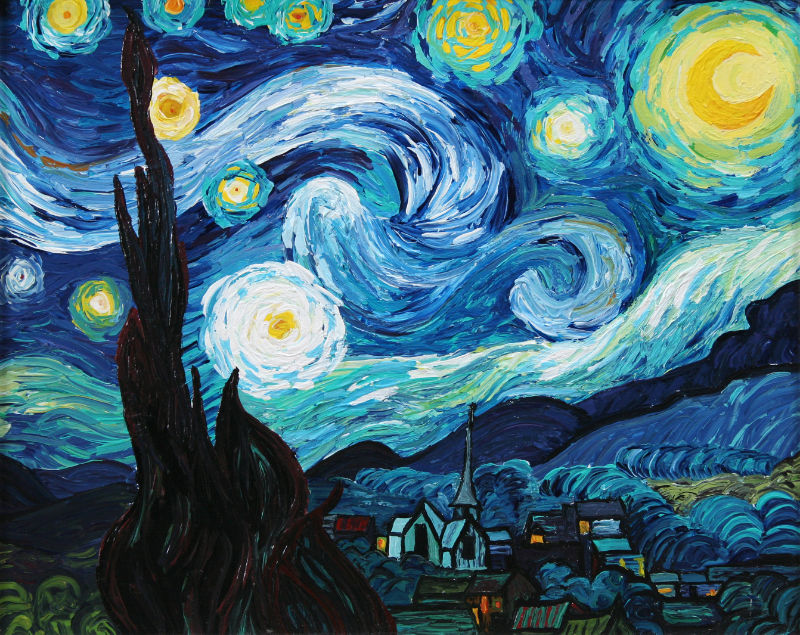
My Starry Night
1995
acrylic on panel
18 x 22 inches
But my artistic journey started well before all that, with this remake of Van Gogh’s Starry Night! My early experience with copying led me to encourage imitation and talk about artists who copy my style as well as a tech company that named a photo filter after my painting technique!
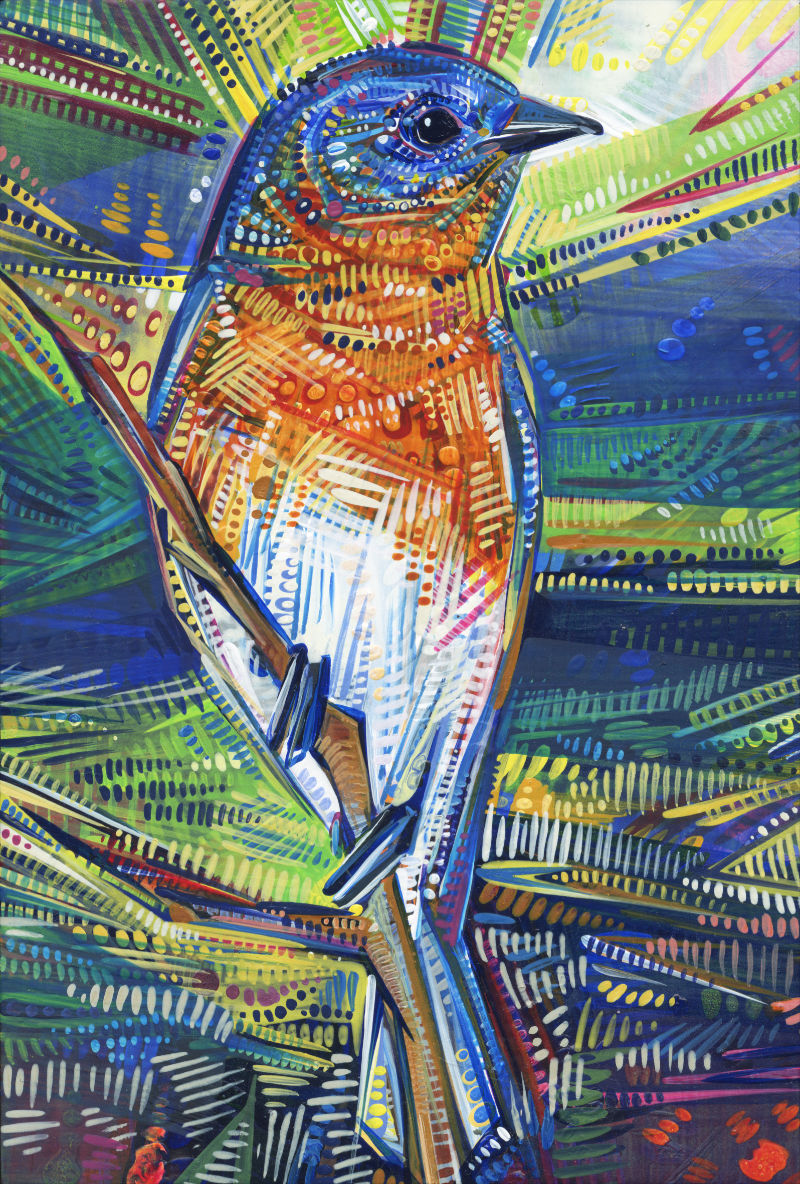
Happy Bird (Eastern Bluebird)
2017
acrylic on panel
6 x 4 inches
The original painting is available for $250—see all the artworks that are currently for sale. Prints and other arty items are in my Redbubble shop.
VIDEO TRANSCRIPT
“Why do you put all those little marks on top of a regular painting?”
I got asked that question so much at the beginning of my career—that question or a version of it. It’s actually part of the reason why I started taking process photos and process videos of my work and sharing those photos and videos, because I wanted to show people: I never make a regular painting! Like, no part of this process is regular. It’s all with the marks, from beginning to end.
I’m not one of those chameleon-type artists who can shift styles depending on what they’re doing. I appreciate the skill that it takes to do that and the temperament that it takes to do that. And I think they can make really cool things, and that’s awesome for them. But that’s just not who I am.
I have a way of making, a way of seeing. My hands just do what they do, and my heart knows what it wants, and it’s all of these little marks! I can shift my style a bit: I can push certain nuances or stay away from others if I want to. But there’s a basic way that I make, and it’s with all of these little marks.
When I was a kid, there was less of that. There was more blending—there was also distinct marks, but not really as much. Not until I was fourteen, and I had this assignment to copy a Van Gogh painting. And I realized that the distinct brushstrokes of Van Gogh really suited me.
Around the same time, I took an intaglio printmaking class, and in that medium the way that you make a tonal area—like a grey area—is to do crosshatching, to do lots of little marks, and so that just fed that way of making, leading to paintings like this one where it’s crosshatching and lots of marks. And this is how I was making at like sixteen, seventeen years old.
Throughout high school, I was also volunteering at a retirement home, and I was drawing the residents at the retirement home. And all of the wrinkles and lines on their faces were also inspiring me. They were bringing that energy to those lines and making me want to emphasize those lines.
Later, after I became a professional artist, I started to acquire more and different kinds of brushes. And these brushes added a whole range and variety to the paintings that I was making. The square, sort of blocky areas that you see in these paintings? Those come from those brushes.
In 2008, I injured my right thumb in a really stupid way. And I was right in the middle of making a whole series of paintings I was going to be showing in just a few months. So I couldn’t stop painting even though my right thumb was really painful. And that’s when I started to really experiment with watering down my paint and pouring it onto the canvas that I put on the floor. I’d been doing a little bit of that—like watering down my paint—from the beginning basically—like from college. But this is when I really was like “okay, I need to do this because I need to add layers to these paintings to eventually be able to finish them.”
In 2012, I made a whole series of paintings on panel, and I did it on purpose because panel intimidated me, and I wanted to get over that. And the reason why panel intimidated me is because, well, it really shows off the brush strokes—like very crisply. And while that’s cool, it’s also a little bit like “woah, too—too much in focus maybe.” But I figured after making fifty-plus paintings on panel, I’d get over my intimidation factor and fall in love, and, sure enough, I did. It really helped me to savor my way of mark-making.
I know that my style will continue to evolve, but the core of how I make is with these little marks. Why do I put all these little marks on my paintings? It’s a version of the original question.
I mean, part of it has to do with the way that I see the world. I know that we’re made up of energy, that that’s what matter is. And that fascinates me, and I want to remember that we are energy. We are always in transition. We are always changing. And I want to capture that with my paintings to remind me and everybody else of that. But I think the simplest answer to the question of “why these marks?” is just that they make me happy.
If you want to know every time I publish new art or blogs, sign up for my special mailing list. You can support my creativity on Liberapay or Patreon, and you can follow my art on Instagram or Facebook.
Maybe this post made you think of something you want to tell me? Or perhaps you have a question about my art? I’d love to hear from you!
To receive an email every time I publish a new article or video, sign up for my special mailing list.
If you enjoyed this post, Ko-fi allows you to donate. Every dollar you give is worth a bajillion to me!