Prickly / Piquant
John Singer Sargent was an extraordinary artist. His work was daring enough to be noticed but wasn’t so daring that it was dismissed. That’s no easy feat for an artist, and I respect him for it. He contributed significantly to transitioning the tastes of the 19th century public and making more unconventional work more acceptable.
John Singer Sargent est un artiste exceptionnel. Son œuvre a été assez audacieux pour être remarqué sans être trop choquant. Ses tableaux ont aidé à faire une place aux œuvres moins conventionnels et ont contribué à la transformation des goûts du public du 19ème siècle.

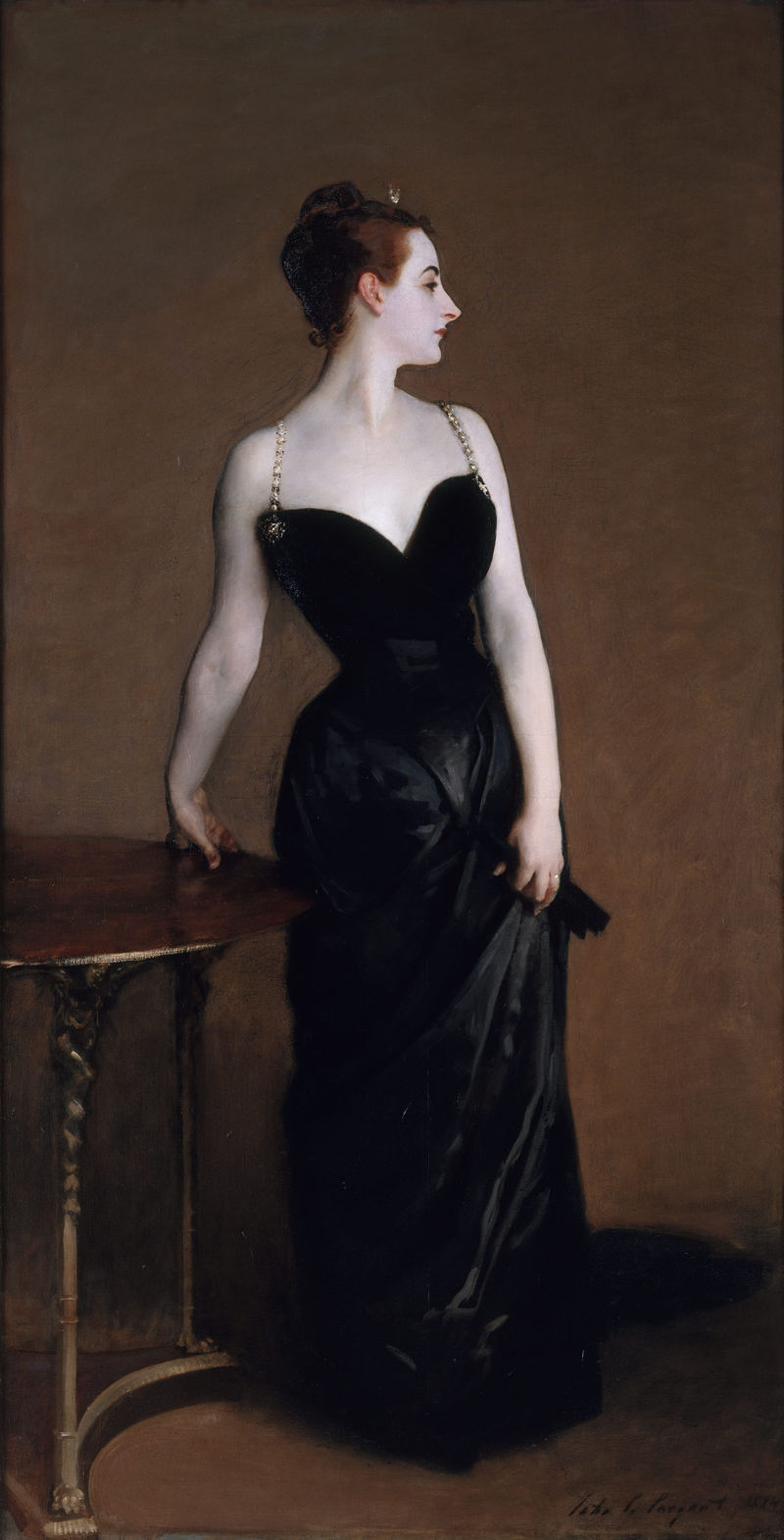
John Singer Sargent’s Madame X 1884
Madame X de John Singer Sargent 1884
Only once did Sargent slip up in negotiating the changing aesthetics of his age, and that was with this piece which was considered too risquée by his public. But, with the exception of Madame X, Sargent’s work walked the line between the traditional and the avant-garde well enough to help him to become a popular portrait artist and make a tidy living painting faces.
Une seule fois, Sargent a mal jugé l’évolution esthétique de son âge, et c’était avec le portrait de Madame X. Ce tableau a été trop risqué pour son public. Mais, à l’exception de ce portrait, le travail de Sargent a toujours demeuré dans l’espace étroit entre la tradition et l’avant-garde, et le souci qu’il se faisait pour se trouver là a fait de Sargent un portraitiste populaire.

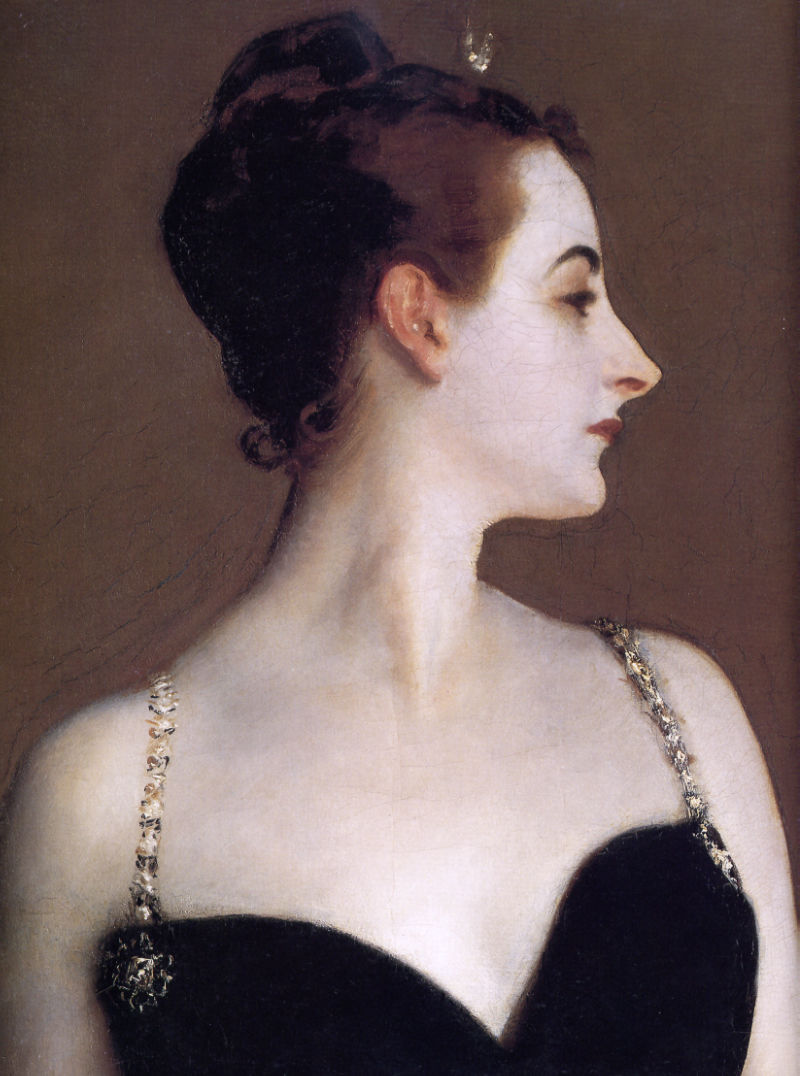
detail image of John Singer Sargent’s Madame X 1884
détail de Madame X de John Singer Sargent 1884
I might also honor him for making his way with commission work, except that he seems to be the posterboy among academics for how commission work robs artists of their originality. And historians haven’t assigned this role completely arbitrarily.
Normalement j’aurais du respect pour un artiste qui gagne sa vie en faisant des portraits sur commande, sauf que Sargent est l’exemple préféré parmi les intellectuels d’un artiste qui a son originalité étouffée en travaillant sur commande. Et les historiens de l’art n’ont pas attribué ce rôle sans cause.

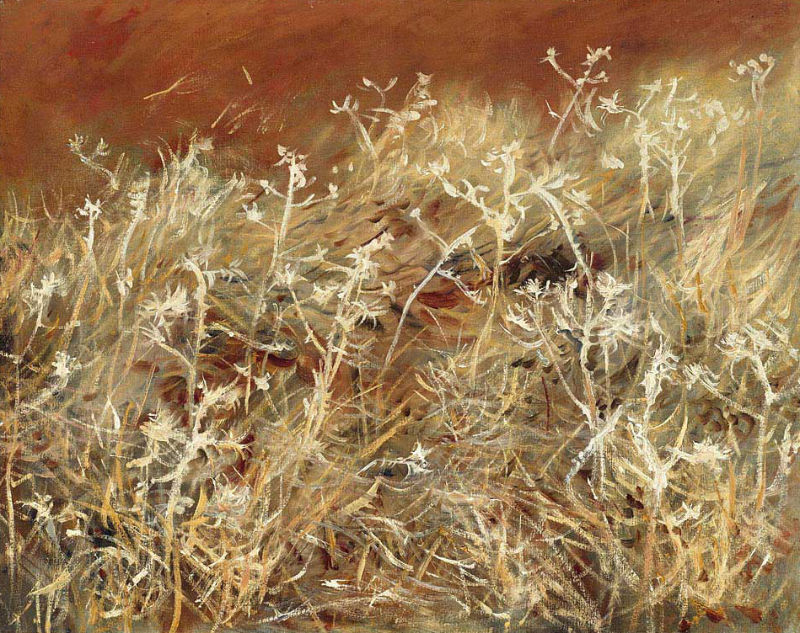
John Singer Sargent’s Thistles 1885-89
Les Chardons de John Singer Sargent 1885-89
At some point in his career, Sargent complained about commission work and he did so bitterly. In 1901 he wrote from Palermo in Sicily: “I have come to this tuberculous place to avoid portraits” (quoted in Elizabeth Cayzer’s Changing Perceptions: Milestones in Twentieth-Century British Portraiture 1999).
À un certain moment dans sa carrière, Sargent s’est plaint du travail sur commande qu’il faisait. En 1901, il a écrit de Palerme en Sicile: «Je suis venu à cet endroit tuberculeux pour éviter les portraits.» (Cité dans Changing Perceptions: Milestones in Twentieth-Century British Portraiture d’Elizabeth Cayzer 1999.)

detail image of John Singer Sargent’s Thistles 1885-89
détail des Chardons de John Singer Sargent 1885-89
Which is probably why I took such a guilty pleasure upon discovering this ugly painting by Sargent at the Art Institute of Chicago last month.
Ce qui est sans doute la raison pour laquelle j’ai pris un tel plaisir à découvrir cet horrible tableau par Sargent à l’Institut d’Art de Chicago quand j’étais là le mois dernier.

I know I’m not supposed to say something like that about another artist’s work. I can question an artist’s intentions and whether or not she-he was successful in executing them, and I’m allowed to imply an opinion, but to state openly that the work is lame is not something that I’m supposed to do.
Je sais que je ne suis pas censée dire des choses comme ça sur l’œuvre d’un autre artiste. J’ai le droit de soulever des questions sur les intentions d’un artiste et si oui ou non il a atteint ses buts. J’ai même le droit d’exprimer mon opinion sur un œuvre d’un autre artiste, mais ce n’est pas correct de faire la déclaration qu’un tableaux est laid.

I admit to being shocked by how much I enjoyed coming across Thistles. I love a lot of Sargent’s work, and I tend to think that it’s hard to deny his virtuosity as a painter even if the work doesn’t speak to you personally.
J’avoue être surprise par l’intensité de ma réaction aux Chardons. J’aime beaucoup l’œuvre de Sargent, et je pense qu’il est difficile de nier sa virtuosité en tant que peintre même si ses tableaux ne vous intéressent pas personnellement.

But the pleasure I take in seeing Sargent fall flat with his Thistles has very little to do with how I feel about the artist and everything to do with how protective I feel towards commission work, which has such a bad—and entirely undeserved—reputation among academics and artists alike.
Le plaisir que je prends à voir Sargent échouer avec ses Chardons n’a rien à voir avec ce que je pense de l’artiste. C’est plutôt que je me sens responsable de la réputation du travail sur commande. Les intellectuels et les artistes critiquent l’œuvre des artistes qui gagnent leur vie ainsi et je trouve ça moche.

A few months ago, I had a conversation with another artist about art and money. During the course of our discussion, the artist asked me if I would continue to make paintings in a certain style in order to pay bills even if I had outgrown that style. I wish I had responded: “well, you keep waiting tables to make money even though you don’t always love it.” I didn’t, and it’s beside the point anyway.
Il y a quelques mois, j’ai eu une conversation (en anglais) avec un artiste sur le carrefour entre l’art et l’argent, et cet artiste m’a demandé si je continuerais à faire des tableaux que je ne voulais pas faire juste pour payer le loyer. J’aurais voulu répondre: «Eh bien, tu es garçon de café pour gagner ta vie même si ça ne te plaît pas toujours.» Mais ce n’est que l’esprit de l’escalier, et, de toute façon, ça passe à côté du sujet.

Commission work does not compromise the artist’s integrity unless the artist is doing it wrong. And if he hated it so much, it’s possible that Sargent was going about it the wrong way.
Travailler sur commande ne compromet jamais l’intégrité de l’artiste sauf quand l’artiste le fait mal. Si un artiste veut peindre sur commande, il doit d’abords connaître ses limites artistiques—ce qui constitue son art et ce qui tombe hors de sa philosophie en tant qu’artiste. Comme exemple, je vais citer une de mes limites: je peins à partir de photos que je prends moi-même du sujet, et de cette façon je garantis ma vision dès le début de mon processus. Si Sargent haïssait tant le travail sur commande, il est possible qu’il ne savait pas comment définir son art.

Of course, I know nothing about the circumstances surrounding the creation of Thistles, and the painting may very well be some kind of pre-Modernist experiment in abstraction. But there is an irony to just how bad it is. Painting faces may have annoyed Sargent at some point, but Thistles proves that when he didn’t have a person to anchor the composition the results aren’t stellar. Could it be that when he’s truly free to paint as he will Sargent fails? Could it be that limitations feed creativity even when those limitations come from commission work?
Bien entendu, je ne connais pas les circonstances de la création des Chardons, et la peinture pourrait très bien être une sorte d’essai pré-moderniste. Mais le tableau est tellement mauvais qu’il y a une certaine ironie. Peindre des visages a peut-être ennuyé Sargent, mais les Chardons prouve que quand il n’a pas une personne pour ancrer la composition les résultats ne sont pas fameux. Est-ce possible que quand il est vraiment libre de peindre comme il veut Sargent échoue? Serait-ce que les limites nourrissent la créativité, même lorsque ces limites proviennent du travail sur commande?
RELATED ARTICLES:
- Commission work ≠ commercial work
- Making a living is like making a painting
- Why making money from your work makes you a better artist
UN PEU SUR LE MÊME SUJET:
- Art = content + delivery / L’art = le fond + la forme
- Beauty / La beauté
- Do you call yourself an artist? / Prenez-vous le titre d’artiste?
CATEGORIES: - En français - Featuring artists - Portraiture - Practice - Reviews -
(4) Comments / Commentaires: Prickly / Piquant
Kim makes a good point, too, but is too limited to a few periods and artists. The fact is, almost ALL art made befofe the past 200 or so years was comissioned or “limited” by external factors. This isn’t just renaisance art or Victorians….it is ALL of art history (till recently).
And Art has Exploded through these “confines”.
For me, It is HOW Grunwald and Fra Angelico painted that is where the art is, and what I love.
Morandi is one of billions of self-limiting painters, but a good example.
The HOW of his bottles etc. is the key.
Gwen, are these academics/artists etc. even worth talking or paying attention to? Why the concern?
I had a teacher at PNCA who told me it was an insult to call a fellow students work illustration-like. I just thought ” What an idiot.”
IF ONLY my art was worthy of great illustration. I drool over the covers of the New Yorker and find half of the art in Portland Galleries to be BORING.
IF ONLY I was half as good as those artists.
IF ONLY I could roll in the dough from making art I love.
P.S.
The art world does have unspoken limitations.
They may be called trends, but fine art has a FEEL that must be adhered to which is very limiting (i.e. No to blatant religion. Yes to liberal politics etc.)
It has been said that many of the “great” artists of the past 60 or so years chafed at having to re-create their cutting edge paintings to keep the public happy and willing to collect their work. Perhaps it’s the goal of the artist to stay barely ahead of that crushing wave and re-invent themselves before drowning in suffocating adoration.
Hmmmm…I don’t think it’s an ugly painting but it is a surprise. Saying it is not up to snuff with his oeuvre seems a statement of the obvious. The same could be said for many successful artists who step away from their regular subject matter to try something else.
You seem to be a bit on the defensive about commissioned work (?)

Kim...
I think working within limitations does help us hone our creativity. It’s related to the saying, “Necessity is the mother of invention.” Those limitations, self-imposed or external, give you a framework to start wrapping your creativity around.
Also, all the masters of the Renaissance worked on commission. Later, more toward the Regency and Victorian periods artists sought patrons, but they had to work in a way the patrons approved, so it was also a form of commission. And yet I don’t hear art critics complaining that Michaelangelo wasn’t true to his art.
--- -- - --- - ---- - - --- ----- -- -